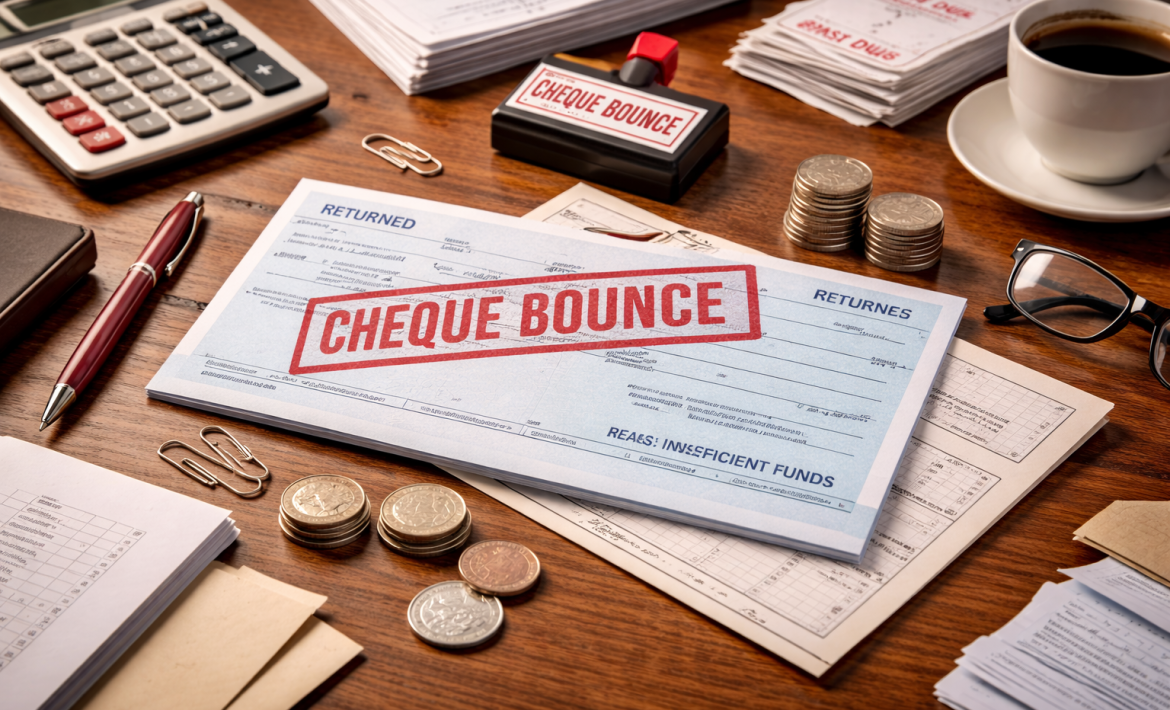

Cheque bounce, also known as dishonour of cheque, is one of the most common financial and legal issues faced by individuals and businesses in India. It occurs when a cheque presented to the bank for payment is returned unpaid due to various reasons. This not only affects financial transactions but can also lead to serious legal consequences under Indian law.
What is Cheque Bounce?
A cheque bounce happens when a bank refuses to honour a cheque. The most common reason is insufficient funds in the drawer’s account. However, other reasons may include signature mismatch, overwriting, account closure, or stale cheque.
In India, cheque bounce cases are primarily governed by the Negotiable Instruments Act, 1881, specifically Section 138, which deals with the offence of dishonour of cheque.
Common Reasons for Cheque Bounce
Understanding the reasons behind cheque bounce can help prevent such situations:
- Insufficient funds in the account
- Signature mismatch
- Incorrect date or overwriting
- Account closed or frozen
- Payment stopped by the drawer
- Technical issues with the cheque
Each of these reasons may lead to legal or financial consequences depending on the circumstances.
Legal Framework: Section 138 of Negotiable Instruments Act
Section 138 makes cheque bounce a criminal offence if certain conditions are met. For legal action to be initiated, the following conditions must be satisfied:
- The cheque must be issued for discharge of a legally enforceable debt or liability
- The cheque must be presented within its validity period (usually 3 months)
- The cheque is returned unpaid due to insufficient funds or similar reasons
- The payee sends a legal notice within 30 days of receiving the cheque return memo
- The drawer fails to make payment within 15 days of receiving the notice
If all these conditions are fulfilled, a complaint can be filed in court.
Penalties for Cheque Bounce
Cheque bounce is a serious offence and can lead to:
- Imprisonment up to 2 years
- Fine up to twice the cheque amount
- Both imprisonment and fine
Apart from criminal liability, the drawer may also face civil consequences such as recovery suits.
Step-by-Step Legal Process
- Cheque Presentation
The cheque is deposited in the bank for clearance. - Dishonour Memo
If the cheque bounces, the bank issues a return memo stating the reason. - Legal Notice
The payee sends a legal notice to the drawer within 30 days. - Waiting Period
The drawer gets 15 days to make the payment. - Filing Complaint
If payment is not made, a complaint is filed before the Magistrate within 30 days after the notice period. - Court Proceedings
The court examines evidence and hears both parties before passing judgment.
Civil Remedies in Cheque Bounce Cases
Apart from criminal proceedings, the payee can also file a civil suit for recovery of money. This ensures that even if criminal punishment is delayed, the financial loss can still be recovered.
Cheque Bounce in Business Transactions
Cheque bounce cases are very common in business dealings. Delayed payments, credit transactions, and lack of financial discipline often lead to disputes. Businesses must adopt proper documentation and payment tracking systems to avoid such issues.
Preventive Measures
To avoid cheque bounce issues, both individuals and businesses should:
- Maintain sufficient bank balance
- Verify cheque details before issuing
- Avoid post-dated cheques without funds planning
- Use digital payment methods when possible
- Keep proper records of transactions
Prevention is always better than dealing with legal complications.
Role of Digital Payments
With the growth of UPI, net banking, and digital wallets, reliance on cheques is gradually reducing. Digital payments offer faster, safer, and more transparent transactions, minimizing the risk of dishonour.
However, cheques are still widely used in formal and high-value transactions, making it important to understand the legal framework.
Jurisdiction in Cheque Bounce Cases
The case is usually filed in the court within whose jurisdiction the bank branch of the payee is located. Recent amendments have simplified jurisdiction rules, making it easier for the complainant to file cases.
Importance of Legal Assistance
Cheque bounce cases involve strict timelines and procedural requirements. Missing a deadline can weaken the case. Therefore, seeking legal advice ensures proper documentation, timely action, and effective representation in court.
Recent Trends and Amendments
The government has introduced various measures to reduce cheque bounce cases, including:
- Encouraging digital transactions
- Strengthening banking systems
- Speedy trial mechanisms
Courts are also focusing on faster disposal of such cases due to the high volume of pending matters.
Conclusion
Cheque bounce is not just a financial inconvenience but a legal offence with serious consequences. Understanding the legal provisions, timelines, and remedies is crucial for both issuers and recipients of cheques. By maintaining financial discipline and using secure payment methods, individuals and businesses can avoid disputes and ensure smooth transactions.
Timely action, proper documentation, and legal awareness are key to effectively handling cheque bounce cases in India.